The short answer: Convert watts and hours to kWh, then multiply by the relevant energy rate. Treat cycling, multiple power levels, and fixed bill charges as explicit limitations.
Before you start
Check the situation in front of you
Useful home guidance begins with the exact space, model, label, and routine you have. Make these checks before turning a general idea into a household habit.
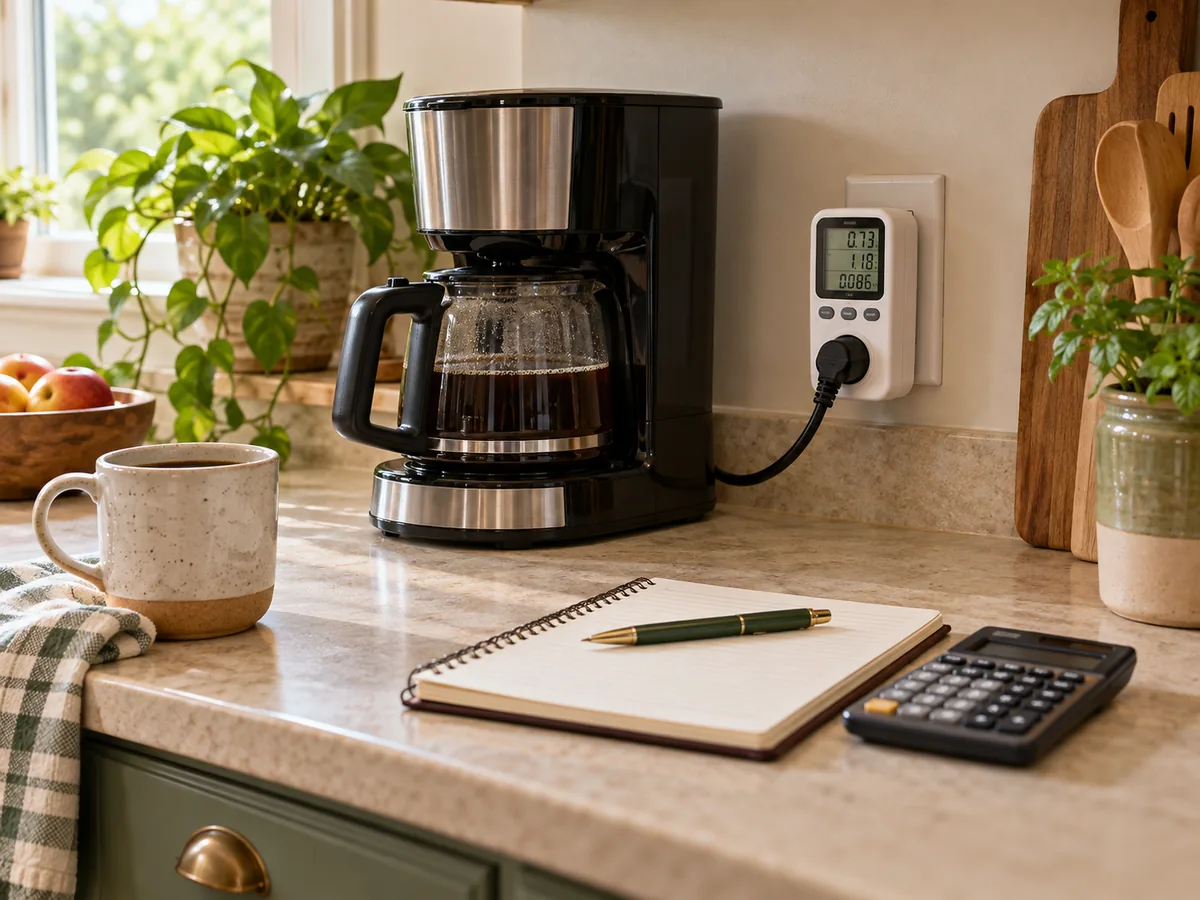
- Use measured watts when a compatible meter can be used safely, or treat nameplate watts as an upper-bound clue.
- Get the energy rate from your own plan.
- Choose a time period that represents actual use.
Try this at home
A practical route, one step at a time
Move through the sequence in order. Keep notes on what you observe, and change only one variable at a time when you want to understand the result.
- 1
Write the power assumption
Record watts and where the number came from: meter, manual, or label. If the device has several modes, name the mode instead of calling one value the appliance’s permanent draw.
- 2
Estimate operating hours
Use a timer, device log, or a short observation diary. Separate active hours from standby when both matter rather than blending them into a guess.
- 3
Convert to kilowatt-hours
Multiply watts by hours and divide by 1,000. A 100-watt device used for three hours consumes an illustrative 0.3 kWh for that period.
- 4
Apply your rate
Multiply kWh by the applicable energy price. At an illustrative $0.20 per kWh, 0.3 kWh costs $0.06 for that day and $1.80 across 30 identical days.
- 5
State what the estimate misses
Cycling, changing loads, seasonal behavior, time-of-use prices, taxes, demand charges, and fixed fees can make the bill behave differently from the simple multiplication.
Use the guide
A practical result you can keep
Illustrative formula
Watts × hours used ÷ 1,000 = kWh; kWh × your applicable rate = estimated energy chargeReplace every value with your own documented number. The result estimates the energy charge represented by those assumptions, not the full bill.
Make the result repeatable
Use what you noticed, not a perfect-looking setup
Begin with write the power assumption, because that establishes the condition you are actually working with. Then move through estimate operating hours, convert to kilowatt-hours, apply your rate. Those middle checks turn “use watts, operating time, kilowatt-hours, and your own rate for an estimate that clearly states its assumptions.” from a general idea into a sequence you can evaluate in your own home.
Give the change enough time to reveal a pattern, but do not keep adjusting several things at once. Write down the date, the room or device, the exact setting or arrangement, and what happened next. For equipment questions, add the model number and manual page. For room questions, add weather, time of day, and who was using the space. A small record is more dependable than memory after the next bill, load, or season arrives.
Finish with state what the estimate misses. If the result is useful, keep the smallest version that solves the problem and add it to the household notes. If it is inconvenient, inconclusive, or conflicts with an instruction, restore the starting condition. A reversible trial is still useful when it tells you which explanation or purchase does not fit. Keep the record with the matching bill, manual, room note, or shopping question so the next comparison begins with context instead of a fresh guess.
Good to know
Conditions, limits, and the point to stop
Illustrative example, not a savings estimate. Plug-in meters are not appropriate for hardwired equipment or loads outside their rating. Do not open panels or expose conductors to measure a household appliance.
Takeaway
Keep these four points
- Wattage source recorded
- Operating time observed
- kWh calculation shown
- Rate and limitations named
Sources and review
Where the factual guidance comes from
- Virginia Cooperative Extension — Estimating Appliance and Home Electronic Energy UseChecked October 14, 2026
- U.S. Energy Information Administration — Measuring ElectricityChecked October 14, 2026
Read our Editorial Standards or report a correction.