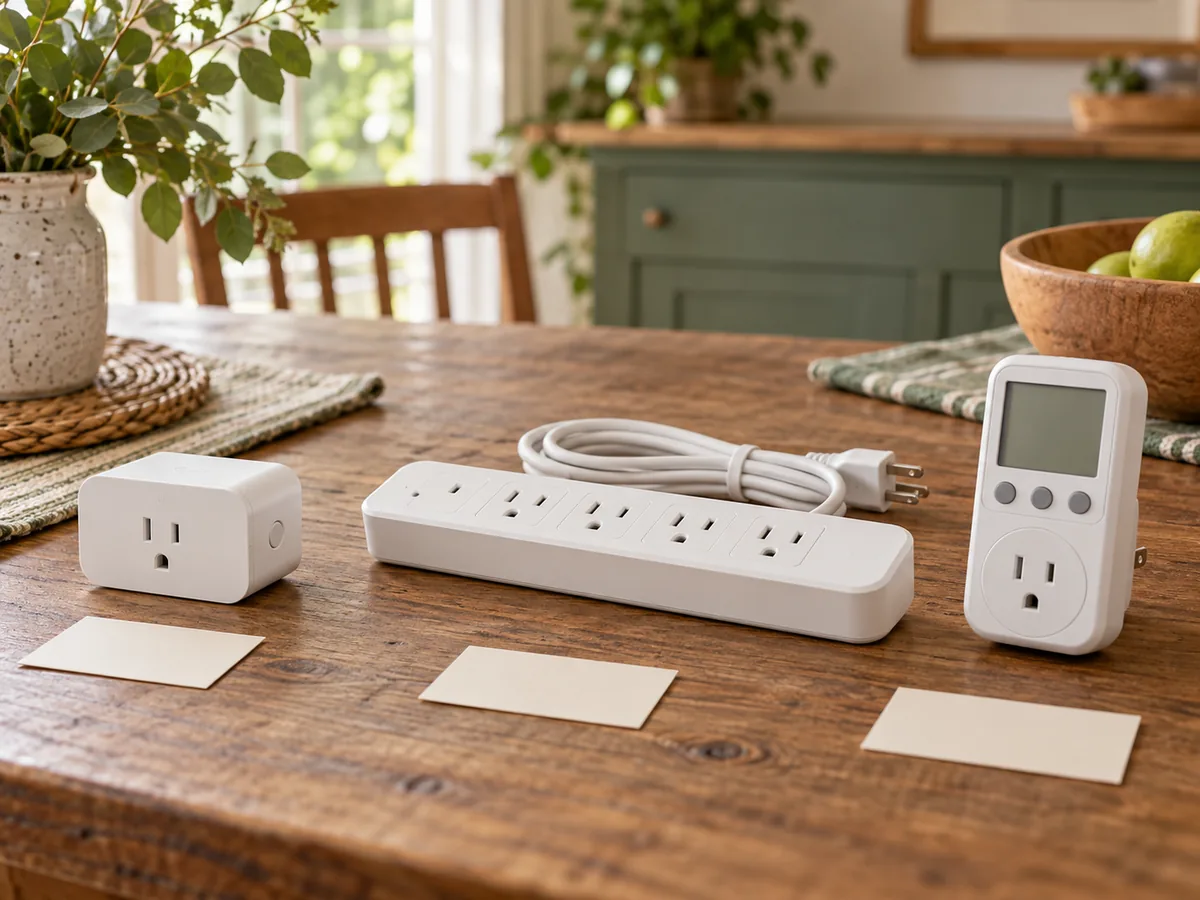
The short answer: A smart plug controls a compatible load, a power strip connects several loads and may add listed protection, and an energy monitor measures use. Some products combine functions, but the box must say so.
Before you start
Check the situation in front of you
Useful home guidance begins with the exact space, model, label, and routine you have. Make these checks before turning a general idea into a household habit.
- Write the exact appliance and job.
- Check voltage, current, power, motor-load, indoor/outdoor, and grounding compatibility.
- Exclude safety-critical and manufacturer-prohibited equipment.
Try this at home
A practical route, one step at a time
Move through the sequence in order. Keep notes on what you observe, and change only one variable at a time when you want to understand the result.
- 1
Choose control when timing is the job
A smart plug may schedule or remotely switch a compatible device. Confirm what happens after an outage, whether internet service is required, and whether local manual control remains available.
- 2
Choose a strip for connections
A listed power strip can provide several receptacles within its rating. Surge-protection status, overload protection, cord length, mounting, and replacement guidance are separate specifications.
- 3
Choose a monitor for evidence
A plug-in monitor can show watts or kWh for compatible plug loads. Panel-level monitors and hardwired equipment involve different installation and safety requirements.
- 4
Read the excluded-load list
Heaters, refrigerators, pumps, air conditioners, medical equipment, and motor loads may be restricted depending on the product. The device and appliance instructions both matter.
- 5
Check the data bargain
For connected products, review account needs, update policy, support period, data collection, export, deletion, and what functions remain if the service changes.
Use the guide
A practical result you can keep
| Product type | Primary job | Verify before buying |
|---|---|---|
| Smart plug | Control or schedule | Load type, rating, outage behavior |
| Power strip | Multiple connections | Listing, rating, protection type |
| Plug-in monitor | Measure a plug load | Range, accuracy, logging |
| Panel monitor | Broader measurement | Professional installation and scope |
Make the result repeatable
Use what you noticed, not a perfect-looking setup
Begin with choose control when timing is the job, because that establishes the condition you are actually working with. Then move through choose a strip for connections, choose a monitor for evidence, read the excluded-load list. Those middle checks turn “choose among control, additional protected connections, and measurement by matching the device to one clearly defined job.” from a general idea into a sequence you can evaluate in your own home.
Give the change enough time to reveal a pattern, but do not keep adjusting several things at once. Write down the date, the room or device, the exact setting or arrangement, and what happened next. For equipment questions, add the model number and manual page. For room questions, add weather, time of day, and who was using the space. A small record is more dependable than memory after the next bill, load, or season arrives.
Finish with check the data bargain. If the result is useful, keep the smallest version that solves the problem and add it to the household notes. If it is inconvenient, inconclusive, or conflicts with an instruction, restore the starting condition. A reversible trial is still useful when it tells you which explanation or purchase does not fit. Keep the record with the matching bill, manual, room note, or shopping question so the next comparison begins with context instead of a fresh guess.
Good to know
Conditions, limits, and the point to stop
Never overload receptacles or strips, daisy-chain strips, use indoor products outdoors, or control equipment contrary to its manual. Fixed wiring and panel work belong with a qualified electrician.
Takeaway
Keep these four points
- One job defined
- Ratings checked
- Critical loads excluded
- Data and support terms reviewed
Sources and review
Where the factual guidance comes from
- ENERGY STAR — Smart Home Tips for Saving EnergyChecked October 14, 2026
- U.S. Consumer Product Safety Commission — Plug Into SafetyChecked October 14, 2026
Read our Editorial Standards or report a correction.